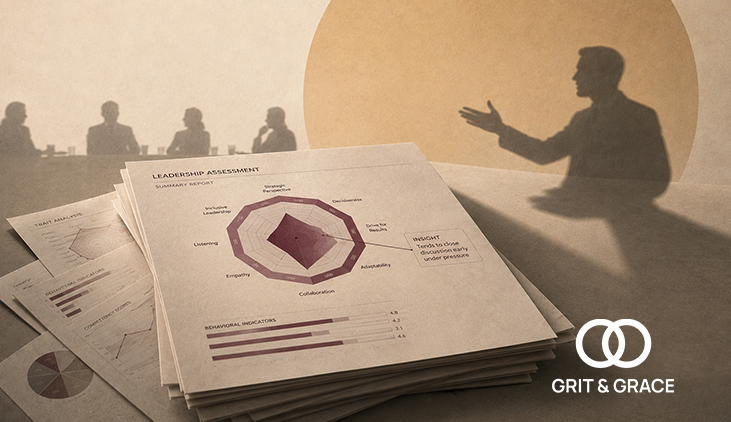
Case Study: Reinterpreting a Leadership Assessment and Turning It Into Behavioural Change
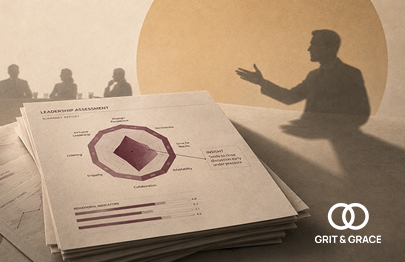
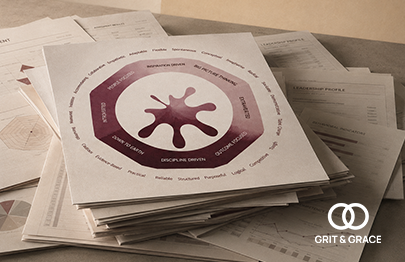
He walked into the session with a sense of clarity and placed the printed Lumina portrait on the table between us, already familiar with its contents. “I’ve gone through this with HR,” he said, almost as a reassurance to himself. “It’s actually quite accurate.” The profile was not new to him. Over the past weeks, he had reviewed it, discussed it internally, and extracted what felt like reasonable conclusions. Strengths were clear, development areas were acknowledged, and a direction for improvement had already been outlined. From his perspective, the work was largely complete.
What brought him into the session was not confusion, but a subtle sense that something in the report remained unresolved, not incorrect, but incomplete. He was a senior executive in a scaling business, operating at the intersection of strategy and execution, where speed and clarity were not optional but required. His Lumina profile reflected this. It showed a strong orientation toward decisiveness, forward momentum, and outcome focus. In everyday behaviour, he moved quickly and with conviction, and under pressure those same qualities intensified. None of this surprised him, as it aligned with how he experienced himself and how others described him.
As we began to work through the profile together, I asked him not to summarise it, but to anchor it in one real situation where his leadership was tested repeatedly. He paused briefly before answering, “Weekly leadership meetings, that’s where most of the pressure sits.” We stayed there, not moving back into theory. As he described the meetings, a pattern began to emerge.Discussions were efficient, decisions were reached quickly, and conversations rarely stalled. From a surface perspective, everything functioned well. Then, almost as an aside, he added, “People don’t push back much.”
Until that moment, this had not registered as a concern. It had been interpreted as alignment, as a sign that the team was moving cohesively and that decisions were clear. But placed next to his Lumina profile, the same observation began to shift in meaning. I asked him what he thought was happening in those moments. He leaned back slightly and answered, “I assume they agree,” and then, after a short pause that carried more weight than the sentence itself, added, “or maybe they just don’t see the need to challenge.”
We returned to the profile, this time not reading it as a description, but as a mechanism. Under pressure, his strengths did not simply remain strengths. His decisiveness accelerated, his thinking moved faster, and his tolerance for prolonged discussion decreased. The intention was efficiency, yet the effect was something else. When I asked what happens in the room when he has already formed a view, he did not respond immediately. He looked back at the document, then away from it, as if mapping it onto something he had experienced but not yet articulated, and finally said, “It probably closes the conversation earlier than I realise.”
That was the moment the insight landed. Nothing in the data had changed. The report had already described this pattern, yet what had been missing was the connection between the pattern and its real impact in a specific context. In his previous discussion, the interpretation had remained at the level of traits, fast, decisive, outcome-driven. In this moment, the same data became behavioural. If conversations were closing earlier than intended, then the apparent alignment in meetings was not necessarily alignment at all. It could just as easily be unspoken disagreement that had no space to surface. The cost of that pattern would not appear in the meeting itself, but later, in execution.
We stayed with that for a moment, allowing the implication to fully register before moving forward. When I asked what would need to shift, his answer came with a different level of precision. “I need to slow the point at which I close the discussion, not the whole meeting, just that moment.” The distinction mattered. He was not trying to change who he was as a leader, but identifying a specific behavioural point where his strength became a limitation.
We made it concrete. In the next leadership meeting, before moving to a decision, he would deliberately create space for opposing views and hold that space long enough for them to surface, even if the instinct was to move forward. Not as a general intention, but as a defined intervention in a recurring situation. As we framed it this way, his posture shifted slightly, the earlier certainty replaced by something more grounded. “This wasn’t obvious from the report,” he said. “I read it as a strength.” I replied, “It is a strength, until the moment it isn’t.”
He smiled, not in disagreement, but in recognition. The data had not been wrong, it had simply been read at the surface level.What changed in the session was not the content, but the depth of interpretation. As we closed, he returned to the initial reason for coming in. “I thought I understood it,” he said, “but I wasn’t seeing what it actually does in real situations.”
For me as a coach, the session reinforced a pattern that appears consistently in leadership work. Assessment tools do not create insight on their own. They provide structured information. The value emerges in how that information is decoded, challenged, and translated into behaviour. Without that step, even the most accurate profile remains descriptive. With it, it becomes operational. In this case, the shift was immediate. One behavioural adjustment, applied in one critical context, had the potential to change how decisions were made across the team, not because the leader lacked capability, but because one pattern had remained unexamined until it was placed under the right lens.