The Missing Process Behind Better Strategic Thinking
Most leadership teams do not struggle with execution, yet they do struggle with strategic thinking. McKinsey research found that while 97% of executives believe strategic thinking is critical to success, only about half believe their leadership teams spend enough time on it. The gap is rarely caused by a lack of intelligence or experience, it emerges because strategic conversations are often cut short before new thinking has a chance to develop.
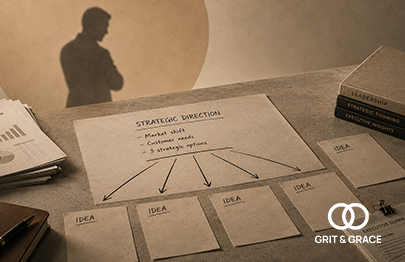
One pattern appears repeatedly in leadership teams. A discussion begins with a question about the future. We all heard them: a new customer segment, an emerging competitor, a changing market dynamic. Within minutes, the conversation shifts to budgets, resources, ownership, timelines, and risks. Instead of exploring possibilities, the group starts evaluating feasibility. The discussion moves from “What might be true?” to “How would we implement it?” before the opportunity itself has been understood.
This confusion between strategic thinking and operational thinking sits at the heart of many innovation challenges.Execution benefits from speed, clarity, and decisive action. Strategy requires something different: the ability to stay with uncertainty long enough to explore alternatives. When leadership teams rush into evaluation too early, they do not reject bad ideas. They often eliminate potentially valuable ones before they have been properly examined.
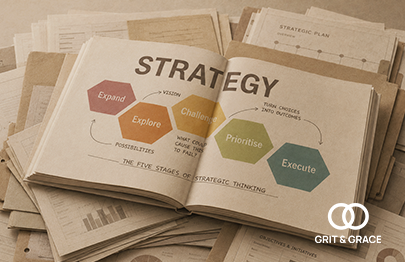
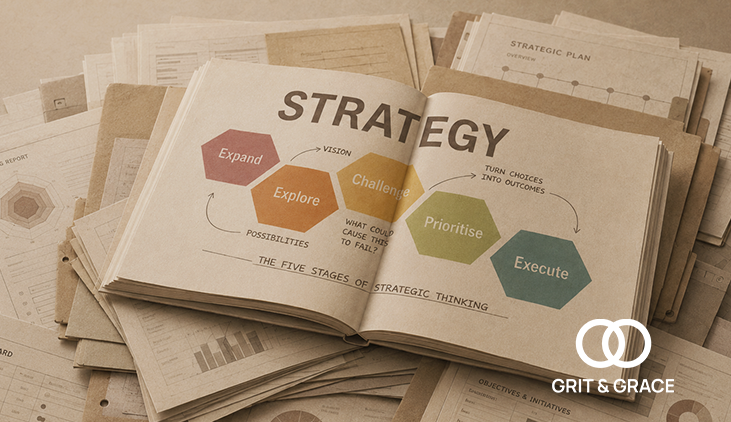
The Five Stages of Strategic Thinking
Many organisations treat strategic thinking as a single activity. In practice, it is a sequence. Strong strategies rarely emerge fully formed. They move through five distinct stages, each requiring a different type of conversation and a different leadership behaviour.
1. Expand: Generate possibilities before evaluating them
When Reed Hastings began exploring the future of Netflix, the company was still successfully mailing DVDs. The obvious question was how to improve the existing model. Instead, the leadership team explored a broader question: what if physical media disappeared altogether? Most of the ideas generated during that period never became products. That was not the point. The goal was to widen the field of possibilities before narrowing it. At this stage, leaders should ask: What are we not seeing? What assumptions are we treating as facts?
2. Explore: Develop ideas before judging them
The first version of a good idea is rarely a good strategy. When Amazon was developing AWS, many leaders viewed it as a distraction from the retail business. Rather than dismissing the concept, the company continued refining it, testing it, and understanding where it might lead. Today AWS generates tens of billions of dollars in annual revenue. At this stage, the leadership task is not evaluation. It is development. The question becomes: What would need to be true for this idea to work?
3. Challenge: Stress-test assumptions
Before entering new markets, Amazon is known for rigorous internal debate. Teams are expected to challenge assumptions, identify weaknesses, and expose risks before major investments are approved. This stage is where many organisations either become overly optimistic or excessively cautious. The objective is neither support nor criticism. It is reality-testing. Leaders should ask: What could cause this to fail? What evidence would change our mind?
4. Prioritise: Choose what matters most
When Steve Jobs returned to Apple in 1997, the company was pursuing dozens of products across multiple categories. Instead of adding more initiatives, he eliminated approximately 70% of the product portfolio and focused the company on a handful of priorities. Strategy is not choosing every good idea. It is deciding which few deserve disproportionate attention and resources. The key question is: If we could pursue only one or two of these opportunities, which would matter most?
5. Execute: Turn choices into outcomes
Only after priorities are clear should the conversation move to budgets, ownership, resources, milestones, and accountability. When Satya Nadella shifted Microsoft toward cloud computing, the strategic decision came first. Execution followed through investment, organisational redesign, capability building, and performance management. Many leadership teams reverse the sequence. They begin with execution questions before strategic thinking is complete.
The failure point in most organisations is not execution. It is moving to execution too early. Teams start discussing resources, risks, and ownership before they have spent enough time expanding, exploring, challenging, and prioritising. As a result, strategy sessions often produce decisions without producing new thinking.
What Hijacks Strategic Thinking
Most organisations do not struggle because they have the wrong people in the room. In fact, the opposite is often true.
- The experienced operator sees obstacles before others do.
- The realist spots risks that might otherwise be overlooked.
- The perfectionist raises the quality bar and pushes for precision.
These strengths are invaluable when the task is execution. Problems arise when they appear too early in a strategic conversation. Before an idea has been explored, it is tested for feasibility. Before alternatives have been considered, constraints dominate the discussion. Before thinking has developed, it is judged.
The issue is not the behaviour itself, but its timing. Strong leadership teams understand that different stages require different contributions. They know when to widen the conversation, when to challenge assumptions, and when to narrow the field. Just as importantly, they know when to hold back.
What Leaders Must Actually Do
Many leaders believe their role is to provide answers. In strategic discussions, their more important responsibility is often protecting the quality of the thinking process. The difference becomes visible in small moments. A team member asks, “Who is going to own this?” before the opportunity has been explored. Someone says, “This won’t work” before the idea has been developed. In both cases, the leader’s task is not to answer the question, but to ensure it appears at the right stage of the conversation.
Here are example of how leaders approach it:
- “Who is going to own this?” → “Let’s explore the opportunity first.”
- “This won’t work.” → “What would need to be true for it to work?”
- “We tried that before.” → “What is different now?”
- “What’s the business case?” → “What are we missing?”
- “Let’s decide.” → “Do we have enough alternatives to choose from?”
The quality of strategic thinking is rarely determined by intelligence. Most executive teams already have enough expertise in the room. The challenge is creating a process that converts expertise into insight. Strong teams know when to expand possibilities, when to develop ideas, when to challenge assumptions, when to prioritise, and when to execute. Weak teams compress all five stages into a single discussion. It feels efficient. It rarely produces their best thinking.
Frequently Asked Questions
What is the difference between divergent and convergent thinking?
Divergent thinking expands possibilities and generates alternatives. Convergent thinking narrows options and moves toward decisions. Effective strategic thinking requires both, but not at the same time.
Why do strategy sessions often become operational discussions?
Many leaders are trained to solve problems quickly. As a result, conversations move toward implementation before opportunities have been fully explored.
What is the most common mistake leadership teams make during strategic discussions?
Mixing exploration, evaluation, prioritisation, and execution in a single conversation. Different stages require different forms of thinking.
Why do good ideas get dismissed too early?
Most ideas appear incomplete in their early stages. Teams often evaluate first-stage thinking as if it were a finished proposal.
What is the leader’s role during strategic conversations?
Leaders shape the process. Their role is often to protect exploration long enough for stronger thinking to emerge before the team moves into evaluation and decision-making.