Case Study: Coaching a Head of Strategy on What is blocking Innovation
Mark arrived at the session carrying a thick notebook mounted with sticky notes in various colors, shapes, forms. A subtle reflection of his creative persona who likes to explore ideas in uncertainly in the corporate rigid system which prefers results and clarity.
As Head of Strategy, he was responsible for facilitating quarterly strategy reviews with the executive team. Over the previous eighteen months he had redesigned much of the company’s strategic planning process. The organisation invested in market research, competitor analysis, customer insights, and annual planning exercises. External experts were occasionally invited to challenge assumptions and provide fresh perspectives.
On paper, the process looked robust.
Yet something was bothering him: “The board keeps asking where the next wave of growth will come from,” he said. “And honestly, I don’t think we have a good answer.”
The company was doing almost everything leaders typically associated with success. Revenue was growing, margins remained healthy, projects were being delivered, and the organisation had become increasingly disciplined in how it operated. Yet despite investing significant time and effort into strategy sessions, workshops, and planning exercises, the same concern kept resurfacing: the business was getting better at improving what already existed, but not at discovering what might come next.
“We leave every session with a long list of actions,” Mark said. “But when I look back six months later, I struggle to identify anything that fundamentally changed how we think about the business.”
He paused. “Everything feels like optimisation.”
What made the situation particularly difficult to explain was that there was no obvious weakness inside the leadership team. These were experienced executives who understood the industry, knew the customers, and had spent years making complex commercial decisions. If anything, the organisation had become stronger over time. More expertise sat around the table than ever before, yet the quality of strategic innovative thinking seemed to be moving in the opposite direction.
As we explored recent strategy meetings, I asked Mark to walk me through a typical discussion.
He opened his notebook and pointed to a recent example.
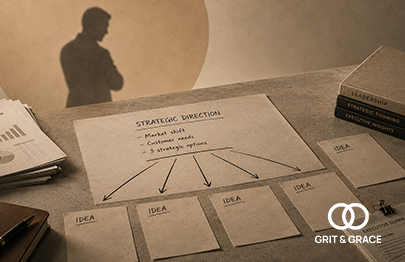
The team had been discussing whether the company should pursue a customer segment it had historically ignored. The idea generated initial interest and questions began:
- What would acquisition costs look like?
- Would existing systems support the move?
- Who would own the initiative?
- What impact would it have on margins?
- How quickly could the business generate a return?
Within ten minutes the discussion had shifted almost entirely toward implementation. The opportunity itself had barely been explored. At the next meeting, a similar pattern appeared.
Someone had suggested a partnership model that differed significantly from the company’s traditional approach. Again, interest emerged briefly. Then the conversation moved toward legal complexity, operational requirements, governance implications, and commercial feasibility.
The idea disappeared as it had been evaluated before it had been developed.
As we continued reviewing examples, the same sequence appeared repeatedly. A possibility emerged. The room immediately tried to execute it.
“What do you think is happening?” I asked.
Mark leaned back in his chair. “I think we’re being disciplined.” His answer made perfect sense. Strong executive teams are trained to evaluate risk, identify constraints, and make decisions. Those capabilities are valuable. The question was whether they were appearing at the right moment.
To test this, I asked him another question. “If we recorded your strategy meetings and analysed the discussion, what percentage of time would you estimate is spent exploring possibilities versus evaluating them?”
“Probably fifty-fifty,” he replied. It seemed like a reasonable assumption.
As we reviewed several meeting agendas and discussion summaries together, a different picture emerged. Most conversations spent only a small amount of time exploring possibilities before moving into feasibility, ownership, risk, and implementation.
The actual ratio appeared much closer to ten percent exploration and ninety percent evaluation.
The insight landed immediately. “We think we’re having strategy discussions,” Mark said. “But we’re mostly having execution discussions.”
Exactly.
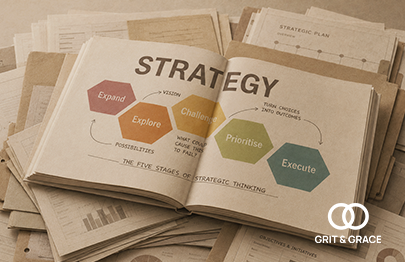
The team had become exceptionally good at answering questions. The problem was that they were rarely spending enough time generating them.
As the conversation unfolded, a metaphor emerged. “What you’re describing sounds a little like a greenhouse,” I said. Mark looked puzzled. “Every strategy session produces seeds. Most of them will never become anything valuable. Some might. The problem is that every time a seed appears, the room immediately digs it up to inspect the roots.”
He laughed. “We’re checking whether it’s profitable before it’s even started growing.”
The image stayed with us.
The leadership team believed they were being rigorous. In reality, they were evaluating ideas before they had been properly explored. The irony was that the people creating the problem were also some of the organisation’s strongest leaders. The COO saw operational realities. The CFO spotted commercial risks. Others challenged assumptions and demanded precision. These were valuable strengths. The issue was timing.
That observation changed the nature of the problem. Up until that point, Mark had been treating the situation as an innovation challenge. Now he began to see it as a process challenge. The organisation did not lack ideas, market knowledge, or strategic capability. It had simply created a conversation structure that favoured answers over exploration. Once an idea entered the room, the pressure to evaluate it appeared almost immediately.
Toward the end of the session, I asked Mark a final question. “If someone in the organisation had a genuinely unconventional idea, what would they need before bringing it to a strategy meeting?”
He smiled immediately. “They would need most of the answers.”
The insight arrived almost instantly. Without realising it, the leadership team had taught people that ideas were welcome only after they had already been validated.
By the end of our session, Mark summarised the challenge himself. “We keep asking execution questions in strategy meetings,” he said. “Then we wonder why nobody brings us unfinished ideas.”
For me, the session highlighted a pattern I encounter surprisingly often. Leadership teams rarely struggle because they lack expertise, experience, or intelligence. More often, they struggle because they become impatient with uncertainty. The pressure to evaluate, decide, and move forward appears so quickly that exploration never has a chance to do its job. As a result, teams leave with decisions, but not necessarily with better thinking.