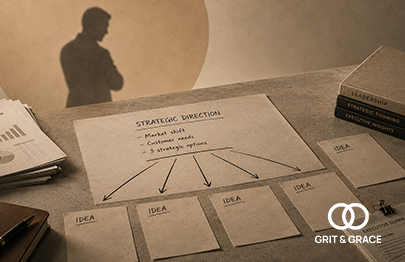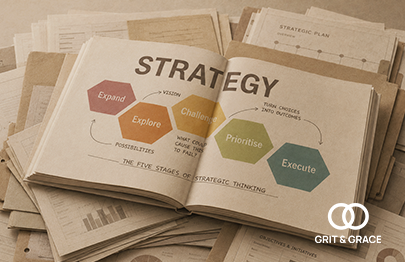
Cascading targets are the difference between a strategy that looks good on slides and one that lands in Monday morning work. I’ve seen the boardroom energy – big vision, head nods, everyone fired up. Then… nothing happens. Why? Because no one translated the strategy into daily work.
The failure isn’t usually the vision — it’s the missing bridge to execution. In my work with CEOs and executive teams across private equity, fintech, and high-growth sectors, I’ve seen billion-pound strategies stall because leaders assumed clarity at the top meant clarity everywhere.
Without explicit translation into roles, responsibilities, and daily actions, even the best strategy becomes a paper exercise. What follows is a practical framework to turn strategic ambitions into measurable targets that drive real performance.
“If your team can’t explain in one sentence how their work connects to the company’s strategy, you don’t have a strategy — you have a poster.”
The Gap Between Vision and Execution
I don’t just launch strategy – I install the wiring that carries it down to the front line. That means cascading goals that turn a company’s ambitions into measurable actions for teams and individuals. When you implement cascading targets well, each level sets time-bound, achievable goals that create alignment from top-level objectives to daily work.
Big goals die without translation.
The problem isn’t complexity; it’s ambiguity. If high-level goals stay abstract, individual employees can’t see how their tasks serve the overarching goals. That’s when conflicting objectives appear, employee engagement drops, and progress blurs because no one can track goals or provide feedback effectively.
Consider the typical scenario: the board approves a strategy to “become the market leader in our sector.” The executive team nods in agreement, but what does this actually mean for the marketing manager trying to plan next quarter’s campaigns? Or the product developer deciding which features to prioritise? Without clear translation, even the most inspiring vision becomes meaningless. An effective cascading goal system ties each step into performance management so you can track progress, spot blockers fast, and keep every decision pointed in the right direction.
Research from Harvard Business Review Research from Harvard Business Review on turning great strategy into great performance demonstrates that the gap between strategic planning and execution is where most organisations fail. Many leaders assume clarity at the executive level travels the same way to the front line – it doesn’t. Each layer needs tailored level objectives and short-term goals that help employees link their own goals to the ultimate goal of the organisation.
Turning Strategy into Steps
Clarity requires structure – and a disciplined goal-setting process that links high-level business objectives to clear tasks and meaningful action at every layer of the organisation. Research shows strategies fail when they stay top-down.
A CEO may set “+15% market share,” but unless department heads translate that into team targets and lower-level goals, it won’t move the needle. Structure is what makes ambition executable. The most effective approach breaks strategy into departmental objectives, then team deliverables, and finally individual actions. Each level gets metrics and timelines that ladder back to the level above, so employee progress is visible and aligned.
Case (fintech scale-up): the board aimed to “double active users in 12 months.” The CEO translated this into clear targets:
- Marketing: 50,000 new users/month via digital campaigns
- Product: +25% feature adoption to lift retention
- Operations: < 2-hour response times to improve experience
- Customer Success: 90% CSAT to drive referrals
The breakthrough came when individual contributors saw how their daily actions linked to growth: email optimisation drove acquisition; onboarding design drove retention. That connection created alignment and motivation.
This disciplined approach mirrors successful buy-and-build plays in private equity: winners don’t just set direction; they re-express the strategy at each layer, translating value-creation themes into specific operational improvements. The principle is simple but often skipped: leaders must provide both direction and interpretation so every person knows what to do – and why it matters.
5 Quick Wins for Strategic Cascading
Here are five quick moves you can roll out this quarter to turn high-level intent into visible progress – simple, repeatable steps that keep every team pulling in the same direction.
- Translate Strategy into Departmental Goals: Convert high-level strategic objectives into specific, measurable goals for each department. Use the same timeframes and ensure clear accountability.
- Break Down Goals into Team and Individual Tasks: Ensure every team and individual understands their specific contribution to departmental goals. Create clear line-of-sight between daily work and strategic outcomes.
- Use a Common Framework: Implement a consistent framework like OKRs (Objectives and Key Results) to maintain alignment across the organisation. This creates a shared language for discussing progress and priorities.
- Create Visual Connections: Use dashboards or visual tools to show how individual work connects to company-wide objectives. Make the connections explicit and regularly updated.
- Regular Translation Sessions: Hold quarterly sessions where leaders explain how strategy translates to their specific area. This ensures ongoing clarity as priorities evolve.
Making Execution Stick
Translate once, reinforce forever.
Cascading targets isn’t a one-off task – it’s an ongoing rhythm that requires constant attention. The best leaders I’ve worked with use regular check-ins, town halls, and one-on-ones to reinforce alignment. This doesn’t mean repeating the strategy word-for-word, but rather showing how the strategy lives in daily decisions, KPIs, and feedback.
The most effective approach involves embedding strategic context into existing management processes. Weekly team meetings should reference strategic priorities. Performance reviews should explicitly connect individual contributions to company objectives. Budget decisions should be explained in terms of strategic alignment.
This constant reinforcement ensures that strategy remains a living guide for the organisation rather than a document that gathers dust. Even when making difficult decisions, such as implementing cost cutting that makes you stronger, clear strategic alignment helps preserve core growth engines while trimming non-essential expenditures.
The rhythm of reinforcement is crucial. Strategy communication should be like a drumbeat – consistent, predictable, and always connecting back to the bigger picture. Leaders should use every interaction as an opportunity to reinforce how individual work contributes to collective success.
Action Checklist for Sustainable Execution
- Break it down systematically: Move from board-level aims to departmental objectives, then to team goals, and finally to individual tasks. Ensure each level has clear metrics and accountability.
- Connect the dots explicitly: Make sure every role understands not just what they need to do, but why their work matters to the overall strategy. Create clear narratives that link individual contributions to company success.
- Reinforce continuously: Strategic alignment decays quickly without regular reinforcement. Build strategic context into all management processes and communications.
When leaders master this approach, execution stops being a bottleneck. Instead, strategy becomes a living system where every team member feels their effort contributes meaningfully to the bigger picture. That’s when strategy truly moves from paper to practice.
Final Thoughts
A strategy isn’t a slide deck – it’s a system for coordinated action. When you turn intent into actionable objectives and keep them visible, you bridge the gap between vision and execution.
I never assume clarity trickles down. I make it visible, practical, and personal, so anyone in the company can tell me in one sentence how they’re driving the mission. Companies that win? They implement cascading goals and translate them at every layer.
Make it a Monday-morning practical: break it down, connect the dots, and reinforce consistently. Do that, and the results follow.
Take the next step
Turn strategy into momentum. Coach’s strategy-to-execution workshops give leadership teams the frameworks and rhythms to cascade targets across the organisation – clearly, quickly, and consistently.
Book a strategy-to-execution workshop and make your Monday-morning strategy show up in daily performance.
Recommended Readings
- How Private Equity Firms Can Ace Buy-and-Build (INSEAD Knowledge (2025)
- Turning Great Strategy into Great Performance (Harvard Business Review)
- Cost Cutting That Makes You Stronger (Harvard Business Review, 2023)